class: center, middle # Protect a Backyard Forest _Protect precious plants from elemental forces_  ##### [The Backyard Forest](https://www.natureworks.org.uk/backyard/) by [Jake Rayson](https://www.natureworks.org.uk) [natureworks.org.uk/backyard/protect](https://www.natureworks.org.uk/backyard/protect/) ###### **Press `P` to see notes and credits**<br>Work licensed under [Creative Commons Attribution-NonCommercial-ShareAlike](http://creativecommons.org/licenses/by-nc-sa/4.0/), embedded work may have other licenses. --- # Course overview <img class="right-img" alt="Young Dogwood windbreak leading down to polytunnel" src="https://res.cloudinary.com/growdigital/image/upload/w_360,h_203/v1551261223/cornus-crop-42141134465.jpg"> 1. [Introducing](../intro/) 2. [Plan](../plan/) 3. [Design](../design/) 4. [<span class="u-bg-aqua">Protect</span>](../protect/) 👈 5. [<span class="u-bg-aqua">Perennial Veg</span>](../veg/) 6. [<span class="u-bg-aqua">Canopy</span>](../canopy/) 7. [Ground Prep](../prep/) 8. [Shrubs & Ground Cover](../shrubs/) ??? * Number 4 in series of 8 lectures in total * First 3 lectures are about observing, planning and designing. * Next 3 lectures getting hands dirty starting the _structure_ of the garden: establishing windbreaks, building features, establishing paths and planting the canopy layer, the big trees. * Final 2 lectures are about filling in the structure: clearing the ground, and then planting the shrubs and the ground cover. --- # What you’ll learn  1. Types of protection 2. Windbreak design 3. Establish hedge 4. Suitable species <h6 class="breadcrumb">Protection – Design — Establish — Species</h6> ??? * Iterative design * Revisit design stage! * Accessibility, Attention, **Protection** --- class: middle, center # 1. Protection <h6 class="breadcrumb"><span class="u-underline">Protection</span> – Design — Establish — Species</h6> --- # Elemental protection 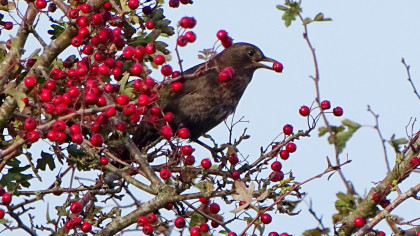 1. Wind 👈 2. Cold 3. Water 4. Predators <h6 class="breadcrumb"><span class="u-underline">Protection</span> – Design — Establish — Species</h6> ??? * Protect from elements * Protect _for_ wildlife — habitat & food * Trees like the company of other trees * Plants grow faster & stronger * Wind & frost damage to blossom --- # 1. Wind  * [Windbreak hedge](https://www.natureworks.org.uk/windbreak/) 👈 * [Dead hedge](https://www.natureworks.org.uk/dead-hedge/) * [Nurse tree](https://www.natureworks.org.uk/nurse-tree/) * Polytunnel etc <h6 class="breadcrumb"><span class="u-underline">Protection</span> – Design — Establish — Species</h6> --- # 1. Wind  * [Windbreak hedge](https://www.natureworks.org.uk/windbreak/) * [Dead hedge](https://www.natureworks.org.uk/dead-hedge/) 👈 * [Nurse tree](https://www.natureworks.org.uk/nurse-tree/) * Polytunnel etc <h6 class="breadcrumb"><span class="u-underline">Protection</span> – Design — Establish — Species</h6> ??? * Temporary until hedges established * Use prunings * Wildlife habitat * Support for climbers Can be elegant! (photo by [John Little](https://www.grassroofcompany.co.uk))  --- # 1. Wind  * [Windbreak hedges](https://www.natureworks.org.uk/windbreak/) * [Dead hedge](https://www.natureworks.org.uk/dead-hedge/) * [Nurse tree](https://www.natureworks.org.uk/nurse-tree/) 👈 * Polytunnel etc <h6 class="breadcrumb"><span class="u-underline">Protection</span> – Design — Establish — Species</h6> ??? * 2-3 plants, quick growing, 2m from protected tree * Ideal UK native is [Broom](https://pfaf.org/user/Plant.aspx?LatinName=Cytisus+scoparius) * Broom is shortlived, nitrogen fixing, needs full sun * Remove nurse tree when protected plant tree enough --- # 1. Wind  * [Windbreak hedges](https://www.natureworks.org.uk/windbreak/) * [Dead hedge](https://www.natureworks.org.uk/dead-hedge/) * [Nurse tree](https://www.natureworks.org.uk/nurse-tree/) * Polytunnel etc 👈 <h6 class="breadcrumb"><span class="u-underline">Protection</span> – Design — Establish — Species</h6> ??? Any shelter really: * Greenhouse * Potting shed * Coldframe --- # Elemental protection  1. Wind 2. Cold 👈 3. Water 4. Predators <h6 class="breadcrumb"><span class="u-underline">Protection</span> – Design — Establish — Species</h6> --- # 2. Cold 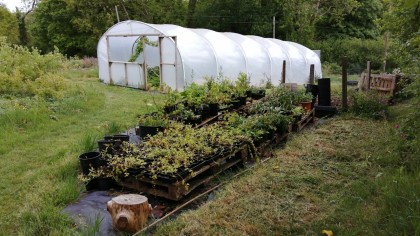 * Polytunnel 👈 * Greenhouse * Potting shed * Cold frame <h6 class="breadcrumb"><span class="u-underline">Protection</span> – Design — Establish — Species</h6> ??? * Solar gain from sun * Polytunnel cheaper than greenhouse * Get human doors & folding windows * Orient north to south, sunny spot * Flat is better! --- # 2. Cold 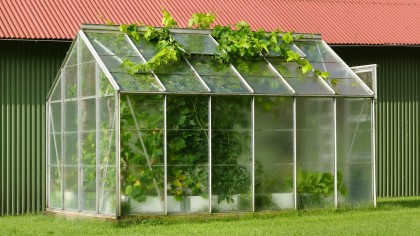 * Polytunnel * Greenhouse 👈 * Potting shed * Cold frame <h6 class="breadcrumb"><span class="u-underline">Protection</span> – Design — Establish — Species</h6> ??? For heated glasshouse: * Martin Crawford’s [Forest Garden Greenhouse Course](https://www.agroforestry.co.uk/product/fg-greenhouse-course/) * [The Forest Garden Greenhouse](https://www.agroforestry.co.uk/product/forest-garden-greenhouse/) --- # 2. Cold 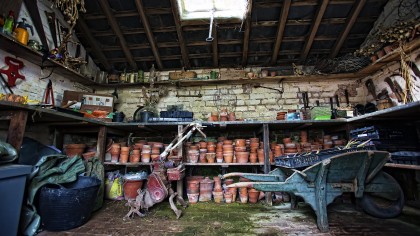 * Polytunnel * Greenhouse * Potting shed 👈 * Cold frame <h6 class="breadcrumb"><span class="u-underline">Protection</span> – Design — Establish — Species</h6> ??? * Like a shed crossed with a greenhouse 😉 * Expensive * Recommended if you 💚 propagating --- # 2. Cold 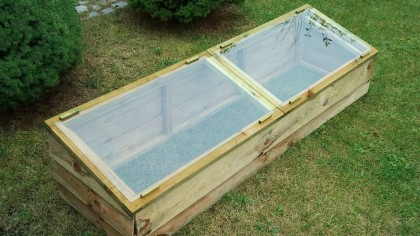 * Polytunnel * Greenhouse * Potting shed * Cold frame 👈 <h6 class="breadcrumb"><span class="u-underline">Protection</span> – Design — Establish — Species</h6> ??? * Much under-rated * Transitional space for [hardening off](https://www.rhs.org.uk/advice/profile?PID=386) * Photo by Ofer El-Hashahar on [Flickr](https://www.flickr.com/photos/best4garden/9016654476/) --- # Elemental protection  1. Wind 2. Cold 3. Water 👈 4. Predators <h6 class="breadcrumb"><span class="u-underline">Protection</span> – Design — Establish — Species</h6> --- # 3. Water  * Taps & hose 👈 * Paths * Harvest rainwater * Swales & mounds <h6 class="breadcrumb"><span class="u-underline">Protection</span> – Design — Establish — Species</h6> ??? * Taps near propagation area * Decent hose! --- # 3. Water  * Taps & hose * Paths 👈 * Harvest rainwater * Swales & mounds <h6 class="breadcrumb"><span class="u-underline">Protection</span> – Design — Establish — Species</h6> ??? * **Essential** for access! * Reduce grass paths, reduce mowing * Woodchip paths need topping up & weeding --- # 3. Water  * Taps & hose * Paths * Harvest rainwater 👈 * Swales & mounds <h6 class="breadcrumb"><span class="u-underline">Protection</span> – Design — Establish — Species</h6> --- # 3. Water 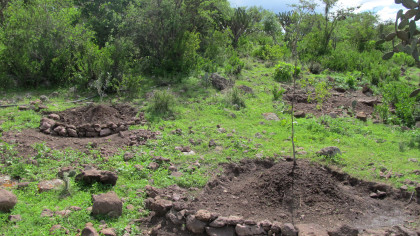 * Taps & hose * Paths * Harvest rainwater * Swales & mounds 👈 <h6 class="breadcrumb"><span class="u-underline">Protection</span> – Design — Establish — Species</h6> ??? * Swales to slow progress of water * Tree mounds to improve drainage for trees Photo by Maria & Thalia on [Raw Culture Collective](https://rawculturecollective.wordpress.com/2011/09/) blog --- # Elemental protection  1. Wind 2. Cold 3. Water 4. Predators 👈 <h6 class="breadcrumb"><span class="u-underline">Protection</span> – Design — Establish — Species</h6> --- # 4. Predators  * Slugs 👈 * Mice * Squirrels * Birds <h6 class="breadcrumb"><span class="u-underline">Protection</span> – Design — Establish — Species</h6> ??? * Reduce habitat by weeding * Treat perennials as annual until mature Photo by Benjamin Dobson [on Flickr](https://www.flickr.com/photos/systemaabstra/6603403827/) --- # 4. Predators  * Slugs * Mice 👈 * Squirrels * Birds <h6 class="breadcrumb"><span class="u-underline">Protection</span> – Design — Establish — Species</h6> ??? Photo by David Short on [Flickr](https://www.flickr.com/photos/14583963@N00/33037462295/) --- # 4. Predators 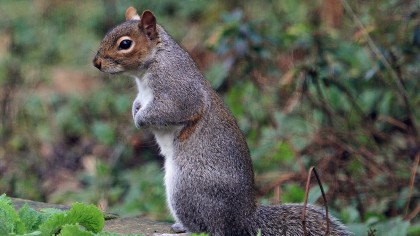 * Slugs * Mice * Squirrels 👈 * Birds <h6 class="breadcrumb"><span class="u-underline">Protection</span> – Design — Establish — Species</h6> ??? * Photo by Rob Hodgkins on [Flickr](https://flickr.com/photos/131806380@N05/33171328992/) --- # 4. Predators  * Slugs * Mice * Squirrels * Birds 👈 <h6 class="breadcrumb"><span class="u-underline">Protection</span> – Design — Establish — Species</h6> ??? ## Most attractive fruit colours to birds In descending order: * Purple * Red * Orange * Black (mulberries) --- class: middle, center # 2. Design <h6 class="breadcrumb">Protection – <span class="u-underline">Design</span> — Establish — Species</h6> --- # 2. Design windbreaks 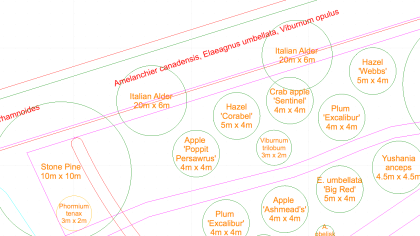 1. Height for protection 2. Aspect dictates height 3. Profile & gaps 4. Stack functions <h6 class="breadcrumb">Protection – <span class="u-underline">Design</span> — Establish — Species</h6> ??? * Plant hedges for **final size** * As with all design, question of balance --- ## 2.1 Height for protection  * Height protects 8x length 👈 * Eg 2m high protects 16m long * Sequence extends protection <h6 class="breadcrumb">Protection – <span class="u-underline">Design</span> — Establish — Species</h6> --- ## 2.1 Height for protection  * Height protects 8x length * Eg 2m high protects 16m long 👈 * Sequence extends protection <h6 class="breadcrumb">Protection – <span class="u-underline">Design</span> — Establish — Species</h6> --- ## 2.1 Height for protection  * Height protects 8x length * Eg 2m high protects 16m long * Sequence extends protection 👈 <h6 class="breadcrumb">Protection – <span class="u-underline">Design</span> — Establish — Species</h6> --- ## 2.2 Aspect dictates height  * Taller hedges North & East 👈 * West sunlight more valuable * Calculate sunlight eg [Sun Surveyor](https://www.sunsurveyor.com) * Check prevailing wind! <h6 class="breadcrumb">Protection – <span class="u-underline">Design</span> — Establish — Species</h6> ??? * Rule of thumb 👍 * **Compromise** --- ## 2.2 Aspect dictates height  * Taller hedges North & East * West sunlight more valuable 👈 * Calculate sunlight eg [Sun Surveyor](https://www.sunsurveyor.com) * Check prevailing wind! <h6 class="breadcrumb">Protection – <span class="u-underline">Design</span> — Establish — Species</h6> --- ## 2.2 Aspect dictates height  * Taller hedges North & East * West sunlight more valuable * Calculate sunlight eg [Sun Surveyor](https://www.sunsurveyor.com) 👈 * Check prevailing wind! <h6 class="breadcrumb">Protection – <span class="u-underline">Design</span> — Establish — Species</h6> --- ## 2.2 Aspect dictates height  * Taller hedges North & East * West sunlight more valuable * Calculate sunlight eg [Sun Surveyor](https://www.sunsurveyor.com) * Check prevailing wind! 👈 <h6 class="breadcrumb">Protection – <span class="u-underline">Design</span> — Establish — Species</h6> --- ## 2.3 Profile & gaps  * Vertical profile better protection 👈 * Baffle/island gap * Staggered gap * Angled gap <h6 class="breadcrumb">Protection – <span class="u-underline">Design</span> — Establish — Species</h6> ??? * Beware frost pockets on slopes * Intentional gaps? --- ## 2.3 Profile & gaps  * Vertical profile better protection * Baffle/island gap 👈 * Staggered gap * Angled gap <h6 class="breadcrumb">Protection – <span class="u-underline">Design</span> — Establish — Species</h6> --- ## 2.3 Profile & gaps  * Vertical profile better protection * Baffle/island gap 👈 * Staggered gap * Angled gap <h6 class="breadcrumb">Protection – <span class="u-underline">Design</span> — Establish — Species</h6> --- ## 2.3 Profile & gaps  * Vertical profile better protection * Baffle/island gap * Staggered gap 👈 * Angled gap <h6 class="breadcrumb">Protection – <span class="u-underline">Design</span> — Establish — Species</h6> --- ## 2.3 Profile & gaps  * Vertical profile better protection * Baffle/island gap * Staggered gap * Angled gap 👈 <h6 class="breadcrumb">Protection – <span class="u-underline">Design</span> — Establish — Species</h6> --- ## 2.4 Stack those functions  * Primarily create microclimate * Wildlife food & shelter * Wood & edible crops * Nitrogen fixing <h6 class="breadcrumb">Protection – <span class="u-underline">Design</span> — Establish — Species</h6> ??? ### Key design takeaways * Height depends on aspect * Plant hedges for final size! * Juggle the variables Nitrogen fixing hedging plants include: * [Autumn Olive](https://pfaf.org/user/Plant.aspx?LatinName=Elaeagnus+umbellata) * [Ebbing’s Silverberry](https://pfaf.org/user/plant.aspx?LatinName=Elaeagnus+x+ebbingei) * [Sea Buckthorn](https://pfaf.org/user/plant.aspx?LatinName=Hippophae+rhamnoides) * [Broom])(https://pfaf.org/user/Plant.aspx?LatinName=Cytisus+scoparius) --- class: middle, center # 3. Establish <h6 class="breadcrumb">Protection – Design — <span class="u-underline">Establish</span> — Species</h6> --- # 3. Establish hedge  * Mulching 👈 * Bare root * Plant wintertime * Tree spade <h6 class="breadcrumb">Protection – Design — <span class="u-underline">Establish</span> — Species</h6> --- # 3. Establish hedge  * Mulching 👈 * Bare root * Plant wintertime * Tree spade <h6 class="breadcrumb">Protection – Design — <span class="u-underline">Establish</span> — Species</h6> --- # 3. Establish hedge 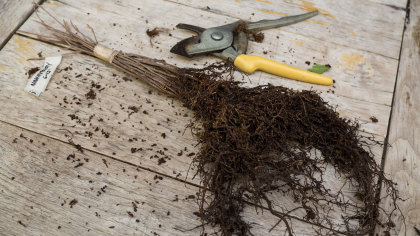 * Mulching * Bare root 👈 * Plant wintertime * Tree spade <h6 class="breadcrumb">Protection – Design — <span class="u-underline">Establish</span> — Species</h6> ??? * Bare root for deciduous only * Much cheaper, about £1 * Winter, from November to March Photo by F. D. Richards on [Flickr](https://www.flickr.com/photos/50697352@N00/16887500507/) --- # 3. Establish hedge  * Mulching * Bare root * Plant wintertime 👈 * Tree spade <h6 class="breadcrumb">Protection – Design — <span class="u-underline">Establish</span> — Species</h6> ??? Photo by F. D. Richards on [Flickr](https://www.flickr.com/photos/50697352@N00/16887500507/) --- # 3. Establish hedge  * Mulching * Bare root * Plant wintertime * Tree spade 👈 <h6 class="breadcrumb">Protection – Design — <span class="u-underline">Establish</span> — Species</h6> --- class: middle, center # 4. Species <h6 class="breadcrumb">Protection – Design — Establish — <span class="u-underline">Species</span></h6> --- # 4. Species 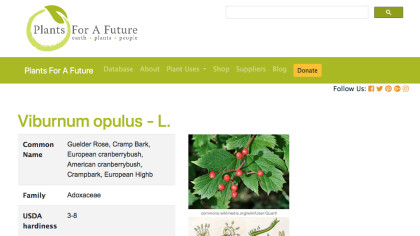 * I am UK-focussed * Native where possible * Bareroot much cheaper * Consider: height, diameter, spines, evergreen <h6 class="breadcrumb">Protection – Design — Establish — <span class="u-underline">Species</span></h6> ??? * Also consider sun & soil * Be aware of invasive plants - _what_ depends on _where_ you are * [Plants For A Future website](https://pfaf.org/user/Default.aspx) is great resource * Bareroot much cheaper * Check PFAF full listing of [plants suitable for hedging and windbreaks](https://pfaf.org/user/cmspage.aspx?pageid=248) --- ## UK Native  1. [European Barberry](https://pfaf.org/user/plant.aspx?LatinName=Berberis+vulgaris) 2. [Guelder Rose](https://pfaf.org/user/Plant.aspx?LatinName=viburnum+opulus) 3. [Sea Buckthorn](https://pfaf.org/user/plant.aspx?LatinName=Hippophae+rhamnoides) 4. [Hawthorn](https://pfaf.org/user/Plant.aspx?LatinName=Crataegus+monogyna) <h6 class="breadcrumb">Protection – Design — Establish — <span class="u-underline">Species</span></h6> ??? * [Database of Insects and their Food](https://www.brc.ac.uk/dbif/hosts.aspx) * [RHS Plant Finder result with Native filter](https://www.rhs.org.uk/Plants/Search-Results?form-mode=true&context=l%3Den%26q%3D%2523all%26sl%3DplantForm%26r%3Df%252Fplant_native%252Ftrue) --- ### 1. European Barberry  * [Berberis vulgaris](https://pfaf.org/user/plant.aspx?LatinName=Berberis+vulgaris) 3m x 2m * [UK native](https://www.brc.ac.uk/dbif/hostsresults.aspx?hostid=736), great for wildlife * Deciduous, edible berries * Large number of needle-like spikes <h6 class="breadcrumb">Protection – Design — Establish — <span class="u-underline">Species</span></h6> ??? * Photo by Michael Mueller on [Flickr](https://flickr.com/photos/104342908@N08/27631930118) --- ### 2. Guelder Rose 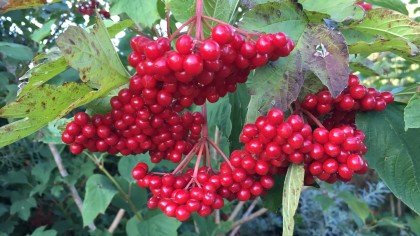 * [Viburnum opulus](https://pfaf.org/user/Plant.aspx?LatinName=viburnum+opulus) 5m x 5m * [UK native](https://www.brc.ac.uk/dbif/hostsresults.aspx?hostid=6045), wildlife magnet * Glorious flowers, * Opulent, almost edible fruit <h6 class="breadcrumb">Protection – Design — Establish — <span class="u-underline">Species</span></h6> --- ### 3. Sea Buckthorn  * [Hippophae rhamnoides](https://pfaf.org/user/plant.aspx?LatinName=Hippophae+rhamnoides) 6m x 2.5m * [UK native](https://www.brc.ac.uk/dbif/hostsresults.aspx?hostid=2664), host to many * Nitrogen fixing; potentially invasive * Vicious spines; edible berries taste of battery acid <h6 class="breadcrumb">Protection – Design — Establish — <span class="u-underline">Species</span></h6> ??? * Photo by gbohne on [Flickr](https://www.flickr.com/photos/gbohne/9049824936/) --- ### 4. Hawthorn 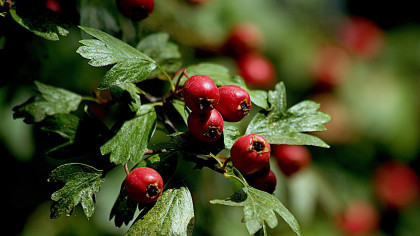 * [Crataegus monogyna](https://pfaf.org/user/Plant.aspx?LatinName=Crataegus+monogyna) 6m x 6m * [UK native](https://www.brc.ac.uk/dbif/hostsresults.aspx?hostid=1665), awesome for wildlife * Some species have much bigger haws * More tree than shrub <h6 class="breadcrumb">Protection – Design — Establish — <span class="u-underline">Species</span></h6> ??? * Photo by manuel m. v. on [Flickr](https://www.flickr.com/photos/martius/21059493764/) --- ## Other recommended 1. [Autumn Olive](https://pfaf.org/user/Plant.aspx?LatinName=Elaeagnus+umbellata) 2. [Juneberry](https://pfaf.org/user/plant.aspx?LatinName=Amelanchier+canadensis) 3. [Ebbing’s Silverberry](https://pfaf.org/user/plant.aspx?LatinName=Elaeagnus+x+ebbingei) 4. [Red Osier Dogwood](https://pfaf.org/user/Plant.aspx?LatinName=Cornus+sericea) 5. [Darwin’s Barberry](https://pfaf.org/user/plant.aspx?LatinName=Berberis+darwinii) 6. [Korean Barberry](https://pfaf.org/user/Plant.aspx?LatinName=Berberis+koreana) <h6 class="breadcrumb">Protection – Design — Establish — <span class="u-underline">Species</span></h6> --- ### 1. Autumn Olive  * [Elaeagnus umbellata](https://pfaf.org/user/Plant.aspx?LatinName=Elaeagnus+umbellata) 4.5m x 4m * Good for pollinators * Nitrogen fixing * Edible fruit <h6 class="breadcrumb">Protection – Design — Establish — <span class="u-underline">Species</span></h6> --- ### 2. Ebbing’s Silverberry  * [Elaeagnus x ebbingei](https://pfaf.org/user/plant.aspx?LatinName=Elaeagnus+x+ebbingei) 5m x 5m * Evergreen, classic Car Park Plant * Nitrogen fixing * Fragrant flowers, edible fruit <h6 class="breadcrumb">Protection – Design — Establish — <span class="u-underline">Species</span></h6> --- ### 3. Juneberry  * [Amelanchier canandensis](https://pfaf.org/user/plant.aspx?LatinName=Amelanchier+canadensis) 6m x 3m * Beautiful early white blossom * Berries in, er, June * Partners well with Guelder Rose <h6 class="breadcrumb">Protection – Design — Establish — <span class="u-underline">Species</span></h6> --- ### 4. Red Osier Dogwood 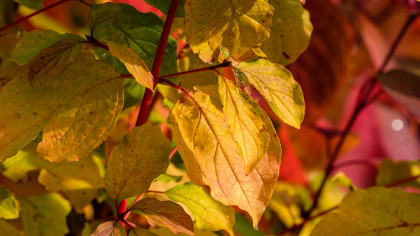 * [Cornus sericea](https://pfaf.org/user/Plant.aspx?LatinName=Cornus+sericea) 2.5m x 4m * Naturalised native * Well-behaved, easy to cut back * Likes moist soils <h6 class="breadcrumb">Protection – Design — Establish — <span class="u-underline">Species</span></h6> ??? Photo by Allan Harris on [Flickr](https://www.flickr.com/photos/allan_harris/48903689207/) --- ### 5. Darwin’s Barberry 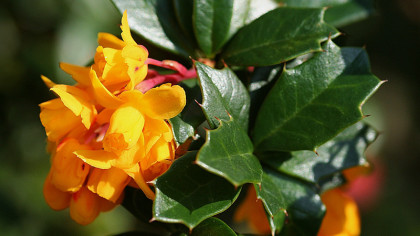 * [Berberis darwinii](https://pfaf.org/user/plant.aspx?LatinName=Berberis+darwinii) 3m x 3.5m * Evergreen, no leaf drop by ponds * Edible berries * Spiney <h6 class="breadcrumb">Protection – Design — Establish — <span class="u-underline">Species</span></h6> ??? Photo by Andy / Andrew Fogg on [Flickr](https://www.flickr.com/photos/ndrwfgg/3454806303/) --- ### 6. Korean Barberry 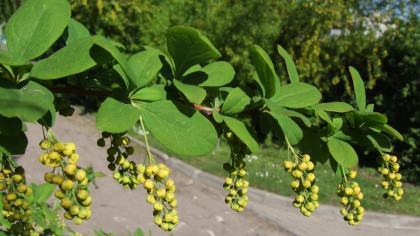 * [Berberis koreana](https://pfaf.org/user/Plant.aspx?LatinName=Berberis+koreana) 1.5m x 1m * Apparently most edible of the barberrys * Barberries known as zereshk (زرشک) in Persian <h6 class="breadcrumb">Protection – Design — Establish — <span class="u-underline">Species</span></h6> ??? Photo by Jerzy Opioła - [Own work, CC BY-SA 4.0](https://commons.wikimedia.org/w/index.php?curid=4052039) --- ## Propagation!  * Bare-root cheap * Propagation cheaper! * Propagate named cultivars <h6 class="breadcrumb">Protection – Design — Establish — <span class="u-underline">Species</span></h6> ??? * If you have the time & space, propagate! * Hedging propagation mostly by cuttings --- # Backyard forest takeaways 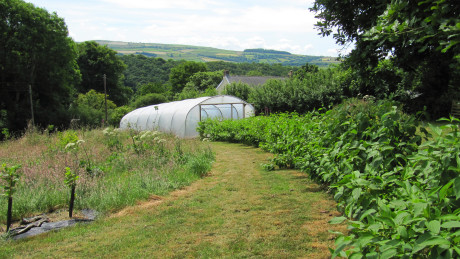 * Windbreaks are priority! * Use temporary windbreaks * Remember **final** width & height <h6 class="breadcrumb">Protection – Design — Establish — Species</h6> --- class: middle, center # The End  <hello@natureworks.org.uk> [natureworks.org.uk/newsletter](https://www.natureworks.org.uk/newsletter) Music: _[Chegsticks](https://iamthemightyjungulator.bandcamp.com/track/chegsticks-3) by [I Am The Mighty Jungulator](https://iamthemightyjungulator.bandcamp.com)_